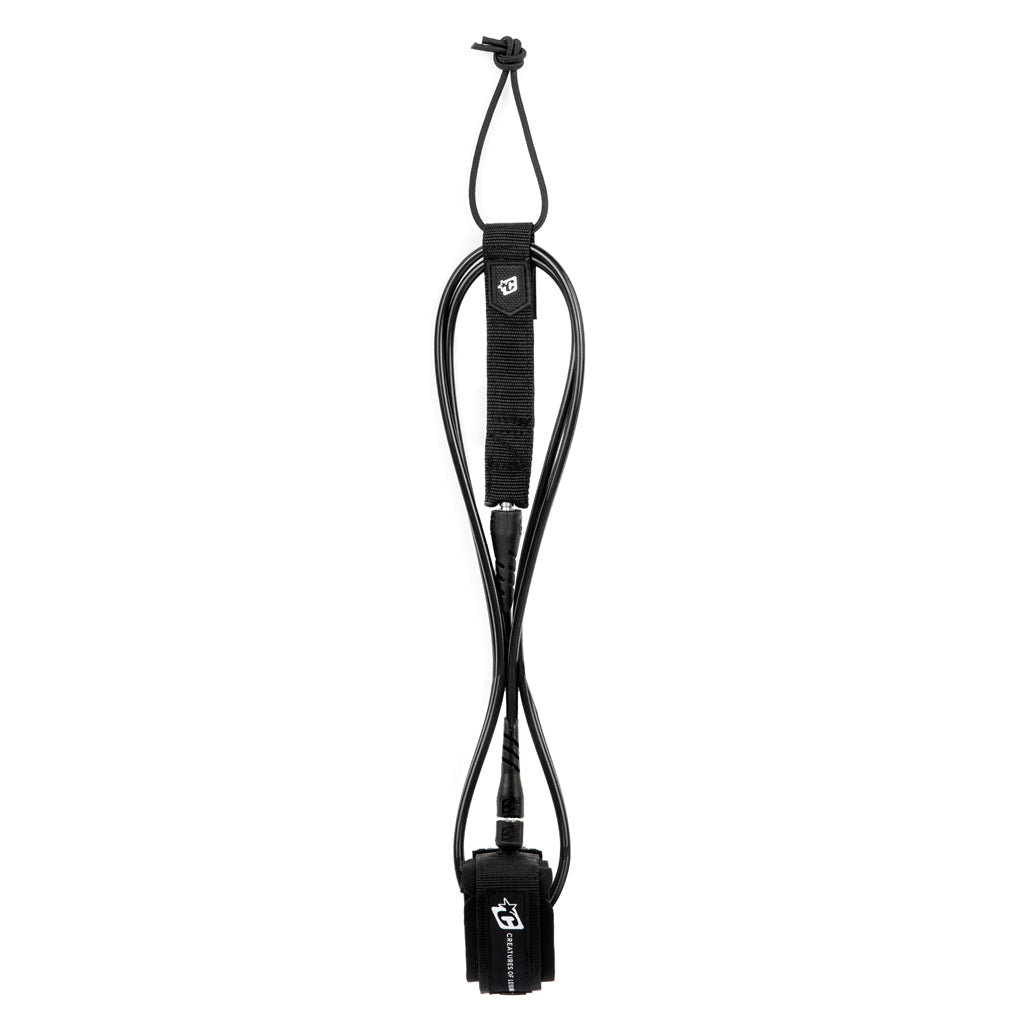
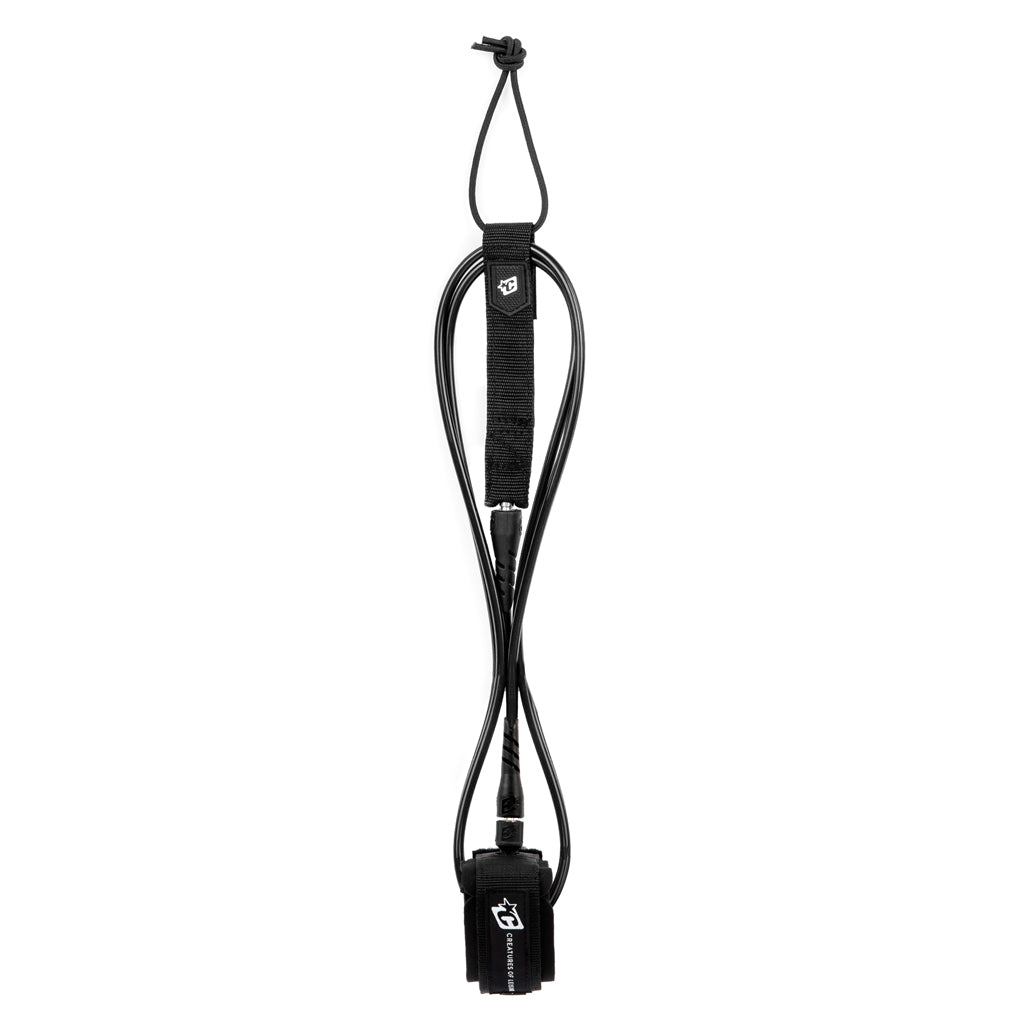
What Leash for a Foam Surfboard?
A leash is the cord that ties your ankle to your board. On a foam board it is the first piece of safety kit to get. Length, thickness, attachment: it all comes down to your board and your conditions. This guide gives you the rule, plus a calculator to settle it in ten seconds.
What a surf leash is for
A leash keeps your board within reach after every wipeout. Without one, your board takes off with the wave and you swim after it, sometimes fifty metres. Worse: a loose foam board in the water becomes a projectile for everyone around you. So a leash is as much about collective safety as it is about convenience. On a busy spot it is not optional.
The golden rule: a leash as long as your board
The rule is simple and it never changes: your leash should be the same length as your board, or very slightly longer. A 7 foot board takes a 7 foot leash.
| Board type | Leash length |
|---|---|
| Shortboard, 5 to 6 ft | 6 ft |
| Mid-length or funboard, 6 to 7 ft | 7 ft |
| Mini-mal or soft-top, 7 to 8 ft | 8 ft |
| Longboard, 9 ft and above | 9 to 10 ft |
Too short and the leash snaps the board back at you too fast. Too long and it drags in the water and tangles. The right length is your board’s length.
What leash for a foam surfboard?
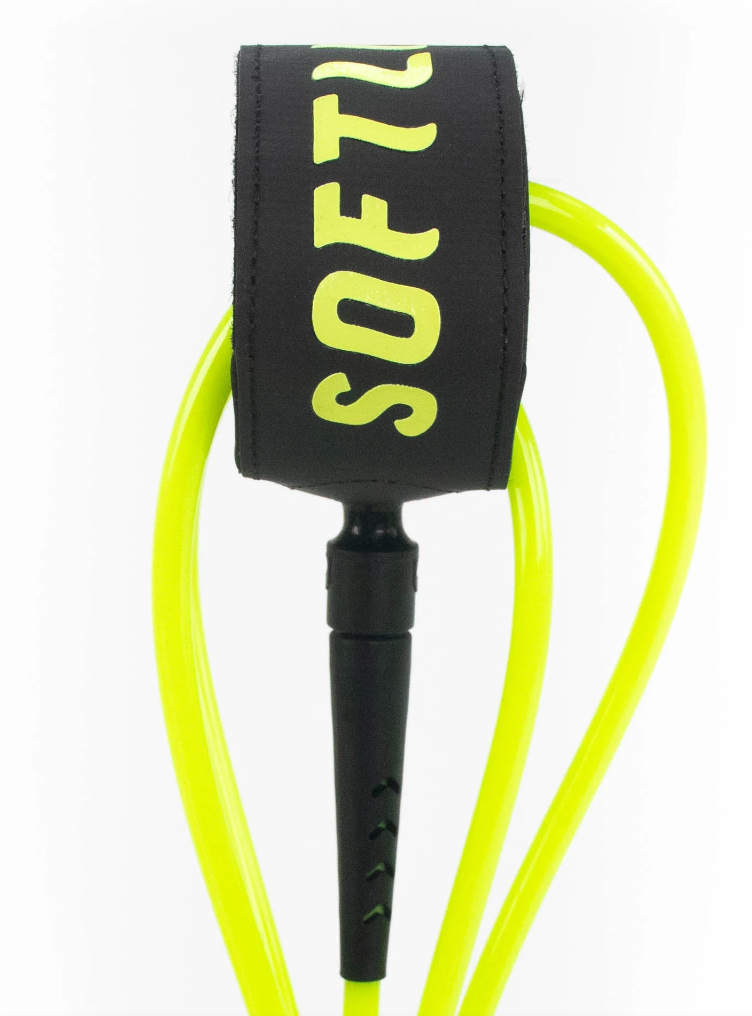
Foam boards are usually 7 or 8 feet, so you take a 7 or 8 foot leash to match. When you are starting out, go for the exact length of your board, or one size up if you are hesitating: a slightly longer leash reduces the risk of the board coming back at your head right after a fall. Strength matters too: on foam you fall a lot and you pull hard. A solid 7 mm cord will take the early days better than a thin competition line.
Cord thickness: pick it for your waves
Thickness is the diameter of the cord. You choose it for the size of the waves, not for the board.
- Small to medium waves, under 5 ft: a thin 5 to 6 mm cord, less drag, more speed.
- Big waves, over 5 ft: a thick 7 mm cord or more, which takes the load without snapping.

To start out on foam in beach break waves, a 6 to 7 mm cord is the right compromise.
Ankle or calf?
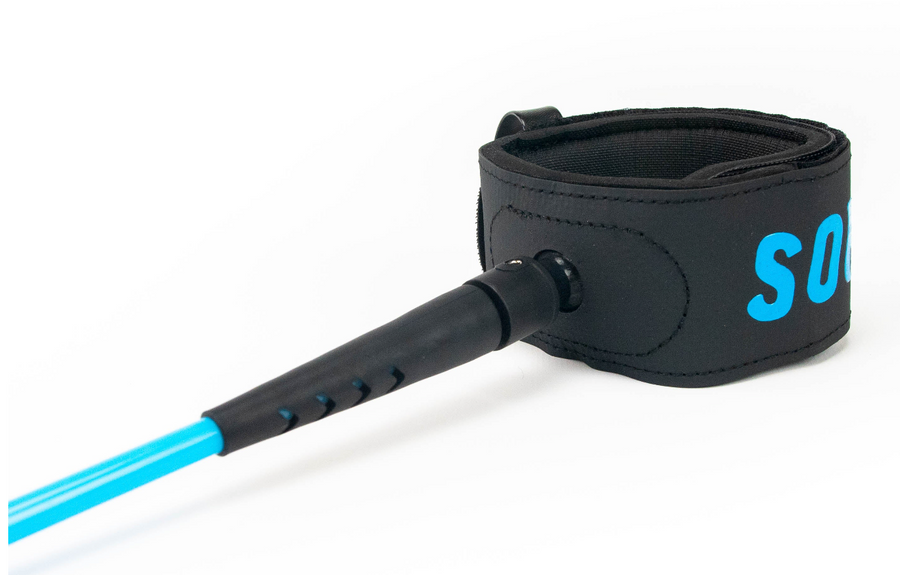
The standard attachment is at the ankle. That is what you want on a foam board as much as on a shortboard: more responsive, less in the way. Knee or calf attachment is for longboarding and stand-up paddle, where you walk the board. For regular foam board surfing, stay at the ankle.
Beginner or experienced: fine-tuning
- Beginner: a leash at the exact length of your board, or one size up. You gain a safety margin after falls.
- Experienced: a leash exactly to length, thinner, to cut drag and sharpen the feel.
How to fit your leash
Fitting is where a lot of beginners get it wrong. Here is how it goes.
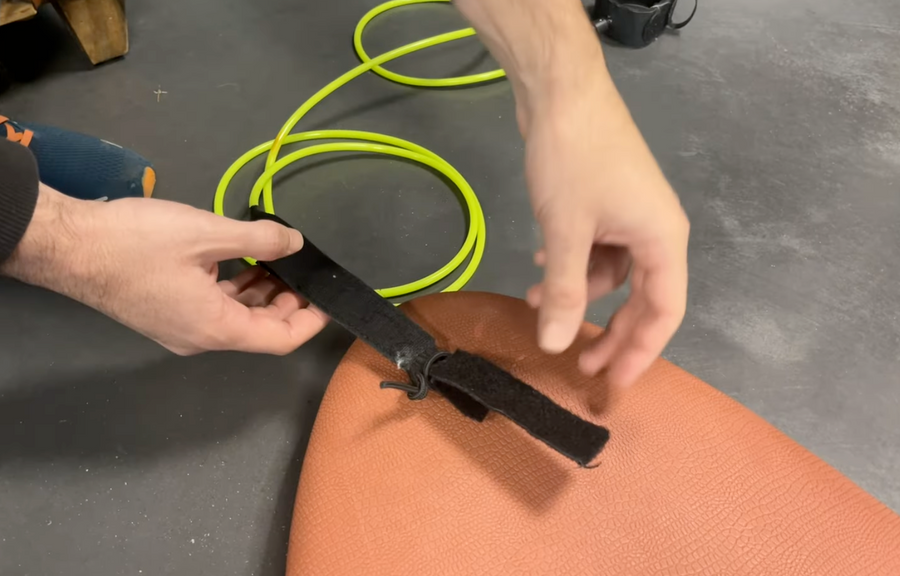
Find the plug
The leash plug is the small recessed box at the tail of your board, with a bar across it.
Thread the string
Pass the leash string through the plug. Make a simple loop: run the end under the bar, feed the other end back through the loop and pull tight.
Attach the leash
The rail saver wraps around the string, never directly onto the plug. That way the string protects the rail.
Check the cuff
Check which way round the ankle cuff sits. A cuff fitted the wrong way eventually pops open in the water: that is the classic mistake.
A properly set string barely sticks out past the tail: too long and it lets the cord rub the rail and wear it down.
Looking after your leash
- Rinse it in fresh water after every session to flush out salt and sand.
- Never store it tightly coiled: the cord keeps the shape and deforms.
- Inspect it regularly. A small nick cuts its strength badly. If in doubt, replace it.
Your leash in ten seconds
Give us your board length and your wave conditions: we give you the leash length and the cord thickness.
A guideline. Take a leash the length of your board, or just above if you are learning.
Frequently asked questions
What size leash for a foam surfboard?
The same length as your board. A 7 ft soft-top takes a 7 ft leash, an 8 ft soft-top an 8 ft leash.
What length leash for a 7 foot board?
A 7 foot leash. The rule is to match the length of the board, or go just above if you are a beginner.
Can you surf without a leash?
Technically yes, but it is a bad idea, especially on foam and while learning. Without a leash you lose your board on every fall and you put the surfers around you at risk.
Thin or thick leash: which should you choose?
Thin, 5 to 6 mm, for small waves and speed. Thick, 7 mm and above, for big waves and strength. To start out on foam, a 6 to 7 mm is the right call.
Which leash brand should you go for?
The safe bets are FCS, Dakine and Creatures of Leisure. Ocean & Earth offers more affordable models. On a foam board, a solid entry-level leash does the job perfectly.
The essentials
A leash as long as your board, a thickness matched to your waves, an ankle cuff, and a clean setup on the plug with the string. On a foam board, aim for a solid 7 or 8 footer and you are sorted. Our complete guide to choosing a surfboard covers the whole board decision, gear included.
Browse the leashesLes autres guides
Choisir sa planche
La méthode complète pour choisir un softboard selon ta taille, ton poids et ton niveau. Lire le guide
Choisir sa combinaison
Épaisseur et type de combinaison selon la saison et la température de l’eau. Lire le guide
Choisir ses dérives
Le rôle des dérives et le bon setup pour une planche de surf en mousse. Lire le guide
La planche de l’enfant
Taille, volume et niveau pour choisir le bon softboard enfant. Lire le guide
Réparer sa planche
Boucher un impact, recoller le pont, prolonger la vie de ton softboard. Lire le guide